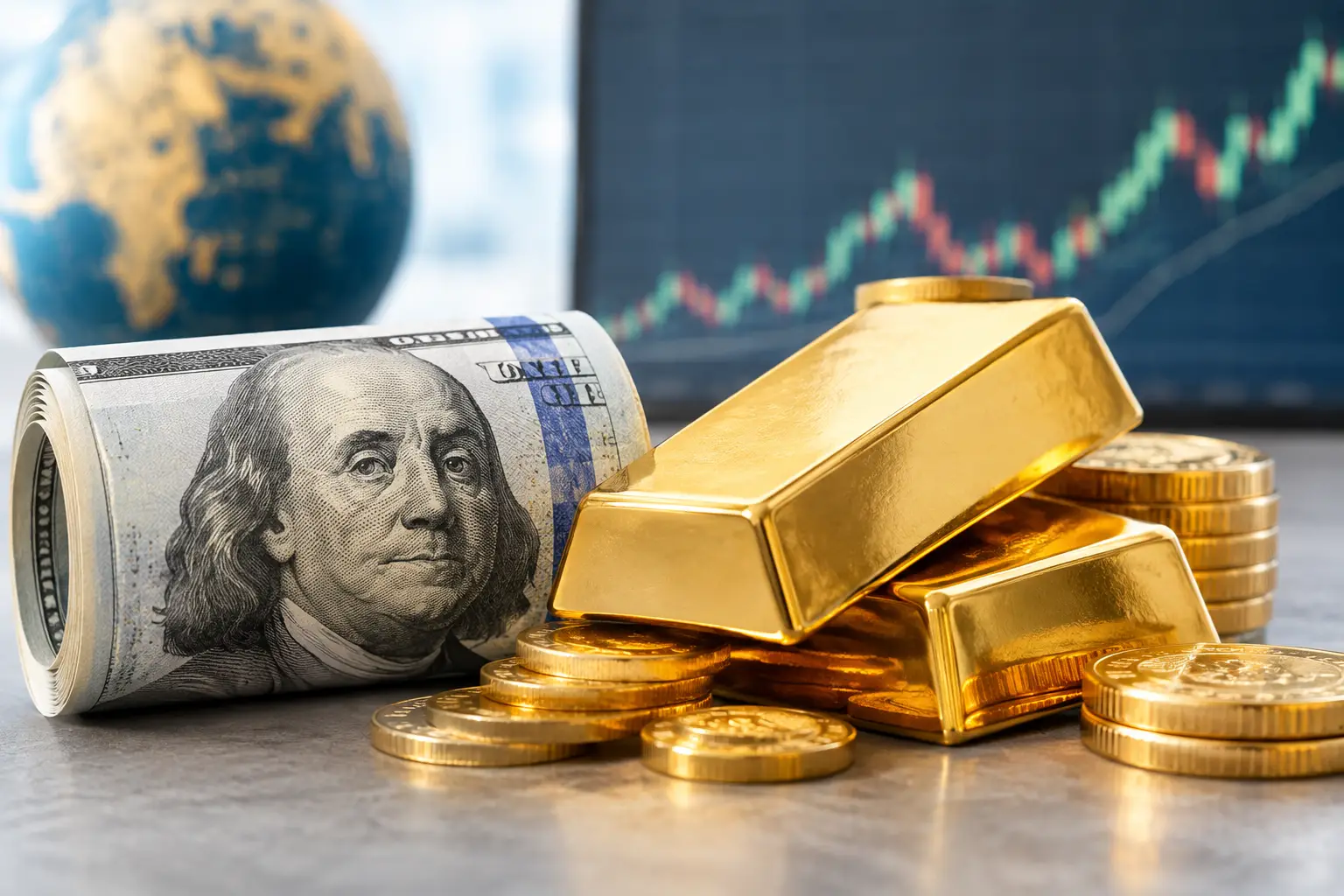
Gold can rally on a frightening headline, then suddenly reverse when the U.S. dollar strengthens. That is why the question of why the dollar affects gold matters far beyond textbook economics. For anyone trading XAU/USD, the dollar is not background noise. It is one side of the price chart.
The common rule is simple: a stronger dollar often puts pressure on gold, while a weaker dollar often supports it. But “often” is the key word. Gold traders who treat this as an automatic inverse relationship can get caught on the wrong side of a fast move. Interest rates, inflation expectations, central-bank buying, and risk sentiment can all change the result.
Why Does the Dollar Affect Gold?
Gold is priced internationally in U.S. dollars. When you see XAU/USD quoted at $2,400, the market is saying one troy ounce of gold costs 2,400 U.S. dollars. This pricing convention makes the dollar the main currency through which global buyers access gold.
When the dollar rises against other currencies, gold becomes more expensive for buyers using euros, yen, pounds, or Malaysian ringgit. If the gold price in dollars stays unchanged but the dollar rises 5% against a buyer’s local currency, that buyer effectively pays more. Demand can cool, especially from jewelry buyers and price-sensitive investors. That creates a headwind for gold prices.
The reverse can also happen. If the dollar weakens, gold may become relatively cheaper for buyers outside the United States. That can improve global demand and help push XAU/USD higher.
This is the first link between the two markets: purchasing power. A stronger dollar changes the affordability of gold around the world.
Gold and the Dollar Compete for Safety
The second link is more psychological. Both gold and the U.S. dollar can be treated as safe-haven assets. During market stress, investors often want liquidity, protection, and assets they believe can hold value.
At times, money flows into the dollar because U.S. Treasury markets are deep and highly liquid. Investors may need dollars to reduce risk, cover losses, or buy U.S. government bonds. In that situation, the dollar can rise while gold falls, particularly during the early stage of a market panic.
At other times, investors worry about inflation, government debt, currency debasement, or long-term geopolitical risk. Gold may then attract stronger demand because it is not issued by any government or central bank. In this scenario, gold can rise even if the dollar remains firm.
That is why traders should avoid thinking, “risk-off means gold must rise.” A risk-off move can initially favor the dollar. The market needs time to decide whether it wants immediate liquidity or a longer-term store of value.
Interest Rates Are Often the Bigger Driver
Gold does not pay interest, dividends, or coupons. Holding physical gold or a gold-linked position means accepting an opportunity cost. When yields on cash, bonds, or other low-risk instruments rise, non-yielding gold can look less attractive.
This is where the Federal Reserve becomes critical for gold traders. If markets expect the Fed to keep rates high or raise them further, U.S. yields may rise and the dollar may strengthen. That combination is usually difficult for gold: investors get better returns from dollar-based fixed-income assets while the currency used to price gold is also appreciating.
If markets expect rate cuts, the opposite can occur. Falling yields can reduce the opportunity cost of holding gold. The dollar may weaken as traders price in easier policy, giving XAU/USD a potential double boost.
However, headline interest rates are not the full story. Real yields matter more. Real yield is roughly the interest rate after adjusting for inflation expectations. If nominal yields rise but inflation expectations rise even faster, real yields may fall. Gold can perform well in that environment despite higher nominal rates.
For example, a jobs report may initially lift the dollar because it suggests a strong U.S. economy and fewer rate cuts. But if later data show inflation staying stubbornly high, investors may turn back to gold as a hedge. Price action can change quickly because the market is constantly repricing the path of rates and inflation.
The Dollar Index Gives Useful Context
Many traders compare gold with the U.S. Dollar Index, commonly called DXY. The index measures the dollar against a basket of major currencies, with a large weight in the euro.
When DXY breaks higher, XAU/USD often comes under pressure. It is a useful confirmation tool, especially around major economic releases. If gold is trying to rally while DXY is accelerating upward and Treasury yields are climbing, the long setup may face stronger resistance.
Still, DXY is not a trading signal by itself. It does not include every currency, and it does not directly measure physical gold demand, central-bank purchases, or geopolitical risk. A rising DXY and rising gold price can coexist when investors are buying both defensive assets.
A practical approach is to watch three markets together: XAU/USD, DXY, and U.S. Treasury yields. When all three tell the same story, the move is often cleaner. When they conflict, reduce confidence and wait for better confirmation.
What Economic News Can Move Both Markets?
Gold and the dollar react strongly to U.S. data because that data influences Fed expectations. The most closely watched releases include inflation reports, nonfarm payrolls, unemployment data, retail sales, GDP, and Fed policy statements.
The details matter more than the headline. A strong payroll number can lift the dollar, but traders will also look at wage growth and the unemployment rate. A lower inflation reading can weaken the dollar, but if it was already fully expected, gold may not rally much. Markets move on the gap between expectations and reality.
Fed communication is equally important. A rate decision may be unchanged, yet gold can move sharply if the Fed chair sounds more hawkish or dovish than expected. Hawkish language generally supports higher yields and the dollar. Dovish language can support gold if it leads traders to expect lower rates ahead.
For active traders, the lesson is straightforward: do not enter a short-term XAU/USD position minutes before a major U.S. release without a clear risk plan. Gold can move rapidly, spreads can widen, and the first move is not always the final direction.
When Gold Rises With a Strong Dollar
This is the exception every trader should understand. Gold and the dollar do not have a fixed inverse relationship.
Both can rise during severe geopolitical tension, banking stress, or a broad rush away from riskier assets. The dollar benefits from its role in global funding and reserve markets. Gold benefits from its role as a perceived store of value. The same fear can support both, but for different reasons.
Central-bank buying can also weaken the usual relationship. If central banks are increasing gold reserves, that source of demand may support prices even when the dollar is strong. Physical demand from major consuming markets, supply constraints, and speculative positioning in futures markets can add further complexity.
For Malaysian traders, local gold prices add another layer. Even if international gold is flat, a weaker ringgit can make gold more expensive in ringgit terms. Someone monitoring only XAU/USD may miss what is happening to the local cost of owning gold. The international chart and the currency conversion both matter.
How to Use Dollar Analysis in a Gold Trade
Start with the larger fundamental question: is the market pricing higher or lower U.S. rates over the next few months? Check whether DXY and Treasury yields agree with that view. Then use your technical setup on XAU/USD to time the trade rather than entering simply because the dollar moved.
For a bullish gold bias, traders often look for a softer dollar, falling yields, and price holding above a key support zone or moving average. For a bearish gold bias, the cleaner environment is usually a firm dollar, rising yields, and gold failing below resistance.
But manage the trade based on invalidation, not conviction. Gold is volatile, and a convincing macro narrative can fail when positioning is crowded or a surprise headline hits. Use a stop-loss level that fits your timeframe, reduce position size around major news, and avoid forcing trades when dollar signals are mixed.
The dollar is a powerful compass for gold, not a guarantee. Read it alongside yields, policy expectations, and price structure, then let disciplined risk management make the final decision.